Beware the Genesis Mission
Government, AI slop, religious overtones, and pseudoscience walk into a bar . . .
The science fiction themes of Silicon Valley roll on with the newly ordered “Genesis Mission,” activated by Executive Order yesterday and calling back to the Bible but, more pertinently perhaps, to Star Trek: The Wrath of Khan, where Project Genesis could be used to “create and destroy so much life” that it could be used to bring life to dead planets or destroy life on thriving planets and replace it.
The Genesis Mission in our case is another version of science fiction — the belief that science via AI can be valid, first of all, and that AI is reliable enough to substitute for humans to discover new things. You may recall that another AI system named with a nod to another science fiction story — The Hitchhiker’s Guide to the Galaxy — let me create a fake science paper in 20 minutes with just a three-word prompt . . .
As Roger McNamee said in our recent podcast interview with him:
We have allowed our medical establishment and scientific establishment to be essentially driven by government funding, which is now controlled by people who don’t believe in science. That is a problem. And Silicon Valley is controlled by people who believe in science fiction. So, you sit there, and you go — Who believes in the real world?
The Executive Order repeats many of the discredited AI tropes that are part and parcel with what already seems like an outdated stance relative to these systems:
- We are in a battle for AI supremacy with China
- The belief that AI solves problems rather than creating new ones
- That AI will accelerate rather than confound scientific discovery
The Genesis Mission will be run by the Secretary of Energy, Chris Wright, a government official who came into the post in February after running a fracking company. During his tenure so far, he has supported the rollback of measures meant to combat climate change and helped create a report by five climate skeptics questioning mainstream climate science — a report actual scientists quickly rebuked. He also has asserted without evidence that solar power cannot meet global energy demands, a statement New Scientist called “wildly embarrassing and wrong.” In short, Wright is a petrochemical shill. He has also pushed for reviews of AI company requests for connections to power grids to be accelerated.
- “General leadership” will be provided by the Assistant to the President for Science and Technology (APST), who is Michael Kratsios, head of the OSTP. Kratsios ran an AI company before rejoining this Trump Administration, and the confluence of OSTP and APST for the Genesis Mission makes the onanism of tech and science complete at the administrative level.
- It also makes it clear that OSTP is no longer about science — just like the current federal government.
The AI platform proposed in the Executive Order has an odd name — the American Science and Security Platform. Points v and vi in this section are worth emphasizing given what they propose the Platform will provide (emphasis mine):
(v) secure access to appropriate datasets, including proprietary, federally curated, and open scientific datasets, in addition to synthetic data generated through DOE computing resources, consistent with applicable law; applicable classification, privacy, and intellectual property protections; and Federal data-access and data-management standards; and
(vi) experimental and production tools to enable autonomous and AI-augmented experimentation and manufacturing in high-impact domains.
So, let’s ponder the datasets:
- Proprietary — Where are these coming from? Will eminent domain be asserted? This is all framed as a national security initiative, after all.
- Open — We’ve already seen open data sources abused by bad AI systems in science, and fake data are easy to promulgate. Watch out here.
- Synthetic data generated through DOE computing resources — Ding! Ding! Ding! We have a winner! Fake data from a politicized arm of a government that doesn’t believe in science.
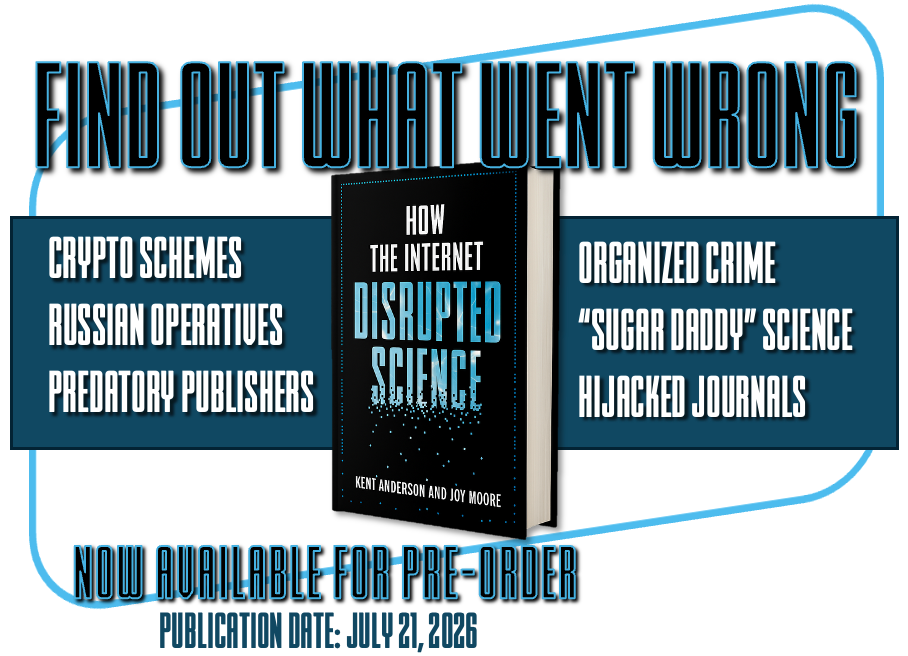
Wright is given 270 days from yesterday to “demonstrate an initial operating capability of the Platform for at least one of the national science and technology challenges” enumerated. That puts it at August 22, 2026 — so about a month after our book — How the Internet Disrupted Science — comes out.
They clearly didn’t factor in this variable . . .
The “challenges” involve advanced manufacturing, biotech, materials, fission and fusion, quantum information science, and semiconductors. Can an AI system demonstrate an initial capability in “quantum information science” based on “synthetic data”? Yeah, duh. That’s an afternoon’s work for a student at MIT who wants to fool a bunch of people.
The narrative around AI and science has shifted dramatically quickly, and this Executive Order is landing with a thud. But that doesn’t mean it won’t create a lot of bad information, deprive actual scientists of resources, time, and training they need to make actual discoveries, or become a political playground for petro interests, charlatans, and grifters.
Watch this space. This feels like an inflection point of some kind.