Destroying Science’s Stories
MAHA’s media is larger and more active than science’s — and better organized
Public health is famous for being underappreciated, but one aspect is even less well-appreciated than clean water, clear air, or safe food — public health is largely dependent on society having an accurate story about modern science.
The story of science developed pretty well — with a few notorious exceptions — from germ theory through to mRNA vaccines via a claims space that was run by experts in managing complex information and earning revenues by serving communities of scientists.
Journalists also became professional specialists during this period. Being a science reporter often meant both having expertise and gaining prestige, and accuracy was expected and consistently delivered. Some great science and medicine reporters emerged, and some still exist today.
But there is something larger and more nefarious afoot in the modern media landscape — the platforming of misinformation.
A group of powerful media manipulators has emerged from a shadowy social media space where their power manifested and found common cause with grifters and charlatans of all stripes — including the social media platforms themselves.
Unregulated due to Section 230 and Silicon Valley libertarian conceptions of “free speech,” and amplified by a pernicious advertising model that made information flow toward extremes, the distortions of the stories of science rumbled beneath our feet until they exploded like a volcano earlier this year.
Ever since then, we’ve been living in the equivalent of a scientific Pompeii.
Nobel Prize winners have watched their lifesaving discoveries shelved — in this case, the mRNA vaccines that saved countless lives and promised to deliver further advances in disease prevention and moderation, with enticing potential around cancers in particular.
Scientists across the spectrum have lost grants, jobs, labs, and positions, many now fleeing to safer havens in Europe and China to continue their work.
The public is being misled. I recently overheard a news channel in a public setting noting that various food dyes had been eliminated, and listing the claimed health harms of these dyes — all fallacious — with the steady cadence they would have used reporting actual science.
The story has changed — and it happened fast.
The MAHA media space is far more robust and refined than we knew. With a single claim dredged out of a preprint or planted in a specious journal, they can pull the trigger on coordinated Substack, YouTube, television, and “gaslight” journal coverage in 24-48 hours, flooding the zone and reaching millions.
° Welcome to “Gaslight Journals”
° The Grifters We Helped Make
° Now It’s “Gaslight” Preprints
° Bad OA and Bleaching Cancer
° Dear Sleuths: Follow the Money
° Our podcast — numerous episodes touching on these issues
Capitalist to the core, companies are seeking advantage. WalMart is creating “superfood” wellness centers to peddle MAHA-inspired products. There will soon be a version of Pepsi made with probiotics and a small amount of cane sugar — it will still be second-rate for Coke drinkers, even if it has its MAHA bona fides.
Judging by the tone and tenor of announcements coming from industry sources, we don’t seem to embrace our role in ensuring an accurate story of science anymore. Take, for instance, this recent headline above the Research Information press release . . . ahem, sorry, repeat after me, “news story” — and show me how this in any way reflects a group of professionals taking care to carefully establish valid, relevant, and reliable scientific claims for specific scientific communities:
1,000 journals now operating on Wiley’s Research Exchange Platform
Every flex in the article is quantitative:
- “to establish multi-stakeholder governance and develop evidence-based AI policies and practices”
- “more than 50% of the company’s journal portfolio”
- “serving more than 350,000 unique users”
- “92% of authors surveyed in the past year have found the system easy to use”
- “25 comprehensive checks at the initial screening”
- “under 10 minutes”
- “received more than 3,300 inputs . . . resulting in 46 major updates to the platform”
This is how you boast about an assembly line, not about delivering relevant and high-quality content to defined audiences.
It also reveals how science — which is about discoveries made and validated by expert communities using evidence of the natural world — conflicts with technology and the degree to which it has been embraced by scientific publishers. Emphasizing quantity, scale, and speed — that’s tech talk, not science talk.
We’ve been overrun by an incompatible culture.
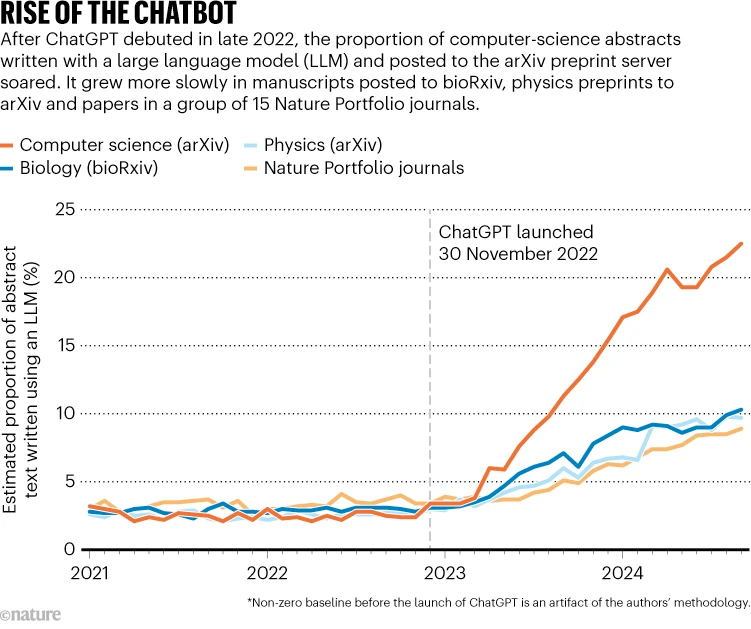
As further evidence, now AI is infiltrating preprints, something that has been totally predictable yet publishers remain supine at best, conspiratorial at worst. “Screening” at preprint servers — by unknown, unaccountable people using unknown, unaccountable processes — is responding with weak tea to hot lava flows of misinformation. This chart from Nature might tell quite a story:
The Gatekeepers’ Pagan Platform Priorities
As tech incentives and habits of mind have been changing society and enabling misinformation, we’ve been playing right along, doling out DOIs to articles that make false scientific claims about AG1, Covid-19 vaccines, fluoridation, and more. And publishers, from MDPI to Frontiers to the AMA, have made money off APCs doing so — while, of course, our polytheistic preprint servers allow even more claims to permeate the system, all of them also sporting DOIs.
CrossRef for its part is a false priest culpable for a lot of the damage, doling out DOIs like indulgences as their cyberlibertarian roots feed off registration event fees. Recently, rather than showing any sense of boundaries, they made a statement about how they wanted to DOI everything, even if it’s obvious garbage. Their euphemism? “Equitable indexing on a global scale.”
Talk about having no standards.
The story of science is being corrupted, undermined, shifted, and retold by a MAHA media space this is poised to exploit even the slightest opening.
And an opening we are providing. The story of scientific and scholarly publishing is being immolated in a gaping and growing chasm between the journals within scientific communities and the ideas and actions coming from the international scientific publishing industry.
In a tragedy of the commons, every society and commercial publisher is protecting their own interests while collectively failing the scientific record and those who rely on it.
We have become pagans, bowing down before tech gods, making mindless pledges to ghosts in the machine, deferring accountability out of superstition, sacrificing our intellects into investments that may never yield results, and throwing our tender brand equity into the burbling volcano of nonsense. It’s all feeding the fire rather than staunching the lava flow.
There is nothing scientific about this.