Google Scholar — Are We Done?
After years of abuse and warnings, it may be time to turn it off

There is a post on our “Disrupted Science” companion newsletter about “disruption” and a recent contemplation about it. Be sure to sign up so you don’t miss a thing.
It’s yours at no extra cost! Go to your account at the top of the page, click on “Manage” for your emails, and add it to the emails you receive from us! Thanks!
We’re letting junk tech make us fat and miserable. And Google Scholar is one major source of tech trans fat in scientific publishing we might want to eliminate.
Less than a year ago, a paper outlined how GPT-fabricated scientific papers were proliferating on Google Scholar. Prior to that, I covered how businesses had sprung up around the well-established ability for bad faith actors to plant citations into Google Scholar, boosting h-indices and other metrics important to the careers of aspiring researchers and ambitious institutions.
The problem goes back to at least 2010 — the year Apple release the first iPad, Lost had its series finale, and One Direction blew up — when a paper documented:
. . . that academic search engine spam is indeed — and with little effort — possible: We increased rankings of academic articles on Google Scholar by manipulating their citation counts; Google Scholar indexed invisible text we added to some articles, making papers appear for keyword searches the articles were not relevant for; Google Scholar indexed some nonsensical articles we randomly created with the paper generator SciGen; and Google Scholar linked to manipulated versions of research papers that contained a Viagra advertisement.
Other papers followed. A cottage industry sprang up around h-index and citation boosters, complete with pricing tiers. LLMs went mainstream, with their risks obvious to anyone evaluating a soft target like Google Scholar. Yet, nothing much seems to have changed.
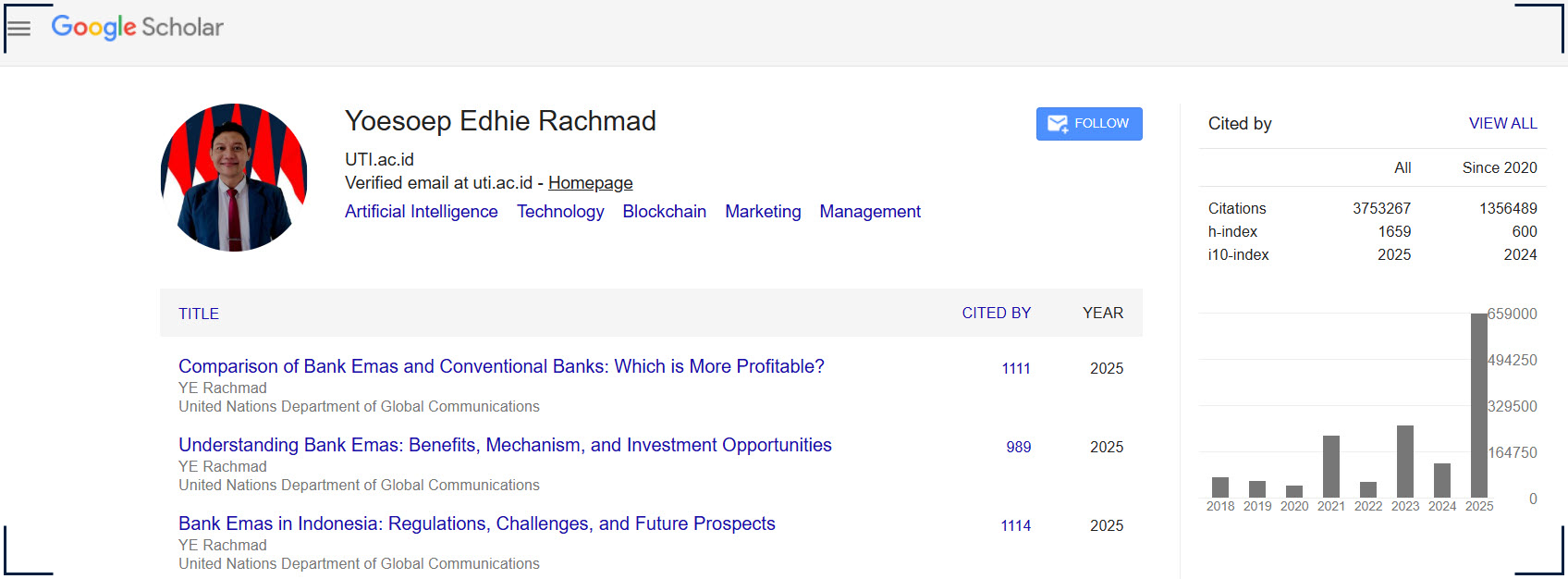
New opportunists have emerged, including Yoesoep Edhie Rachmad, whose Scholar profile (this 404’d later yesterday, but another worked later, also 404’d, so we go to the Wayback Machine) looks like this: