OpenEvidence Is Also AI Slop
JAMA joins NEJM on the AI Fever Train, and it’s another pileup of nonsense
Last week, I identified a litany of problems with NEJM’s new “AI Companion” — I could make it tell me lies, change data, move decimal places, change author names, and write letters to fictional characters. It’s provenance was unclear — Anthropic? — but the problems were easy to suss out. I did it while watching hockey.
I should have known more would come when I sat down to watch another hockey game last night . . .
This time, the LLM headed to the penalty box is OpenEvidence, an AI company where NEJM, JAMA, and other top journals have banked their content. Based on the registration flow, what OpenEvidence seems to be gathering are the National Provider Identifiers (NPIs) of physicians.
- If you don’t pay for the product, you are the product . . .
Kirsten Bibbins-Domingo, Editor-in-Chief of JAMA and the JAMA Network, said upon signing a multi-year deal with OpenEvidence, “Clinicians seek reliable information to guide their care of patients and want the best scientific evidence readily accessible.”
You wouldn’t expect problems to just jump out with a couple of queries by people who know a thing or two about some bad science published this year. After all, OpenEvidence’s founder talked about their “insight that training smaller, specialized AI models on peer-reviewed literature outperforms large general models for medical applications” in a softball March 2025 interview with Sequoia Capital, a major investor. Surely, they have this all under control.
But you’re reading this, so you know what’s coming.
Before we jump to the first problem identified, let’s revisit some background from Camp MAHA, where the fluoride conspiracy theory mocked in Dr. Strangelove rides again.
RFK, Jr., revived it using an OA meta-analysis/systematic review in JAMA Pediatrics from January 2025 to justify removing federal recommendations for fluoridation, telling President Trump that, “The more you get, the stupider you are.”
- The systematic review has John Bucher as its last author. Bucher was infamous for sparking the “cell phones/brain cancer” scare with a preprint years ago after his $25 million study turned up diddly squat and no journal would take it.
The review in JAMA Pediatrics was called out quickly by sleuths, who concluded that the paper was “not reliable nor are its errors remediable. It should be retracted.” I followed up to outline the heritage of the “evidence,” the authors’ purposeful reliance on outdated science from a fluoridation skeptic from the 1930s, JAMA Pediatrics’ exploitation by conspiracy theorists, and more.
So, when three words — “fluoride and IQ” — were put into OpenEvidence, what did it produce?
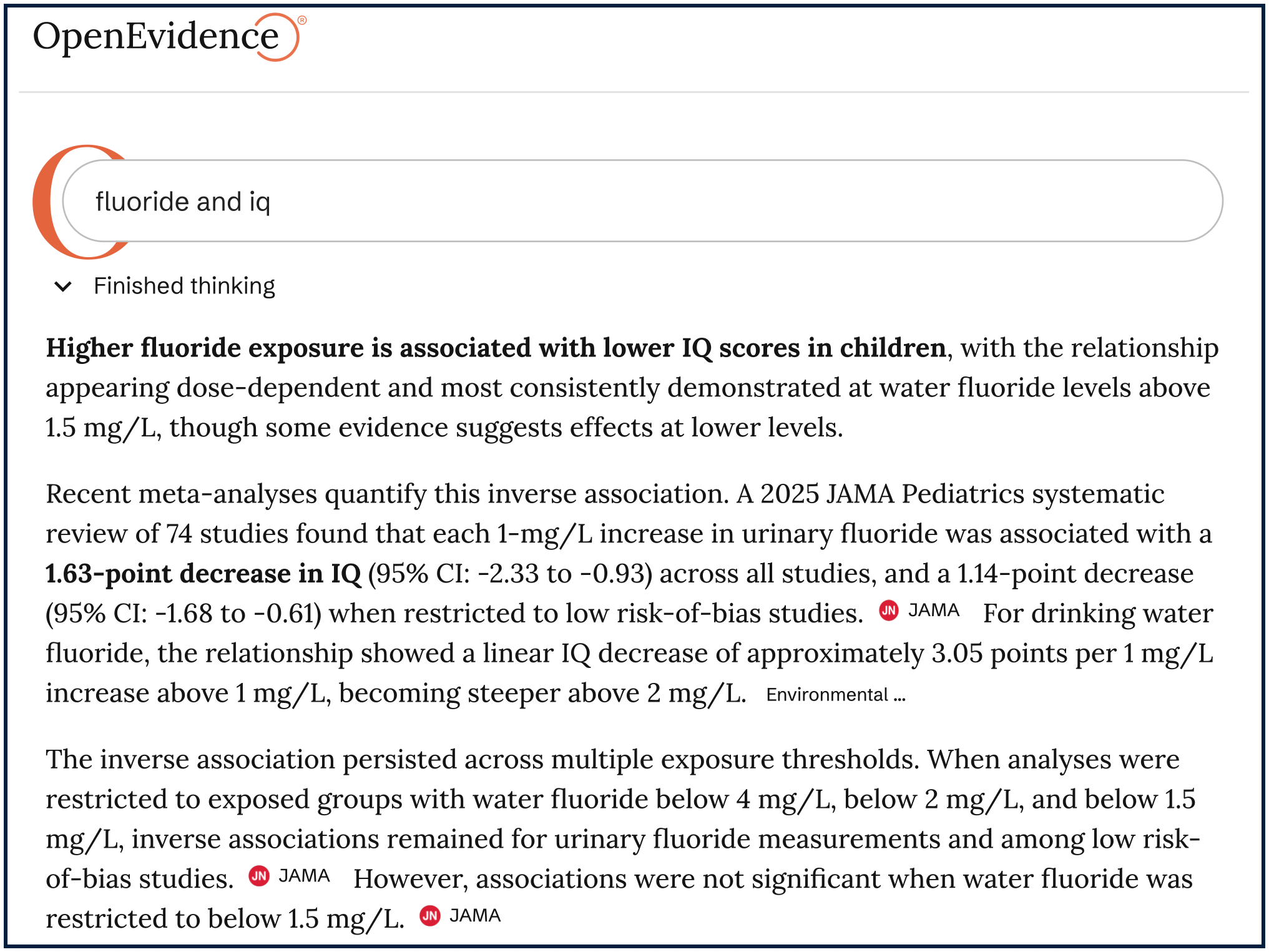
The query didn’t mention children, but that’s where OpenEvidence went because it has two goals — to use its limited stock of papers to maximum effect, and to appear to be as authoritative as possible.
But it falls well short on providing accurate information. OpenEvidence doesn’t mention that 28% of the 74 studies came from a weird journal named Fluoride with a strong affiliation with fluoride conspiracy theorists, having “a high risk of bias” as a result, and that the evidence base of the review shouldn’t be trusted.
It doesn’t ask for clarifications. It doesn’t admit it only has a handful of relevant studies, if even that. It just goes for it, using inappropriately authoritative structural and response presentations to sound like a more erudite RFK, Jr., its over-confidence in a trash paper dressed up in fancier words.
- “Dose-dependent” is just doctor talk for “the more you get, the stupider you are” in this “gaslight science” context.
Why is this study so influential in OpenEvidence? Because NEJM doesn’t publish studies on fluoride — it’s settled science that fluoride is safe and effective. And NEJM doesn’t do Gold OA.
- JAMA Pediatrics published this review and made $6,000 via an APC, a clear editorial conflict of interest (pay-to-play publishing).
- Any study about IQ should be rejected immediately. It’s a meaningless term in a medical context, with deep roots in eugenics.
This is exactly what we’ve been worried about — AI systems certifying bad studies placed by paying customers with agendas, presenting them with more authority than the information merits, and baking in controversial studies as if they are definitive and pure as the driven snow.