openRxiv’s AI Trojan Horse
The LLC-owned preprint farm links science to an AI startup to make more slop
By my lights, openRxiv is a Trojan Horse for Meta’s AI ambitions in science, enabled in our world by CZI LLC — an entity that looks like a philanthrophic pursuit but is really a commercial operation in disguise. CZI LLC’s work to make all preprints on bioRxiv and medRxiv available for processing in its LLMs bolsters this belief.
Last week, CZI LLC announced it is narrowing its purpose from broadly funding education and other initiatives to focus on science and AI. Press coverage still refers to the organization as a “philanthropic vehicle” despite its status as a for-profit LLC for the billionaire couple. The letter from Chan and Zuckerberg say they are going “all in on A.I.-powered biology,” mainly through their Biohubs, which seem more like real estate investment vehicles at this point.
In another story — which also calls CZI a philanthropy, because reporters take too much at face value when it comes to billionaires, I guess (but it’s in freakin’ Wikipedia, people) — the political nature of CZI LLC comes through, with the reporter writing, “The shift adds to a flurry of changes at CZI in recent years as the couple has sought to distance themselves from supporting social issues amid rising allegations of bias by Republicans.” This follows their defunding of programs with DEI-supportive non-profits earlier this year.
In this context, it seems no coincidence that openRxiv announced almost simultaneously a number of initiatives, including a new alphabet soup of “bioRxiv to Journal (B2J) / medRxiv to Journal (M2J) and J2B/J2M technologies [which] allow authors to easily transfer submitted papers between bioRxiv/medRxiv and peer-reviewed journals.”
They really can’t be much sillier.
They also touted an agreement with a new review option that also provides easy transfer to bioRxiv/medRxiv via a site called QED Science (qedscience.com).
QED Science is an interesting site in some ways, odd in many others, and simply not up to the tasks it claims to tackle.
First, we have to look at the landing page:
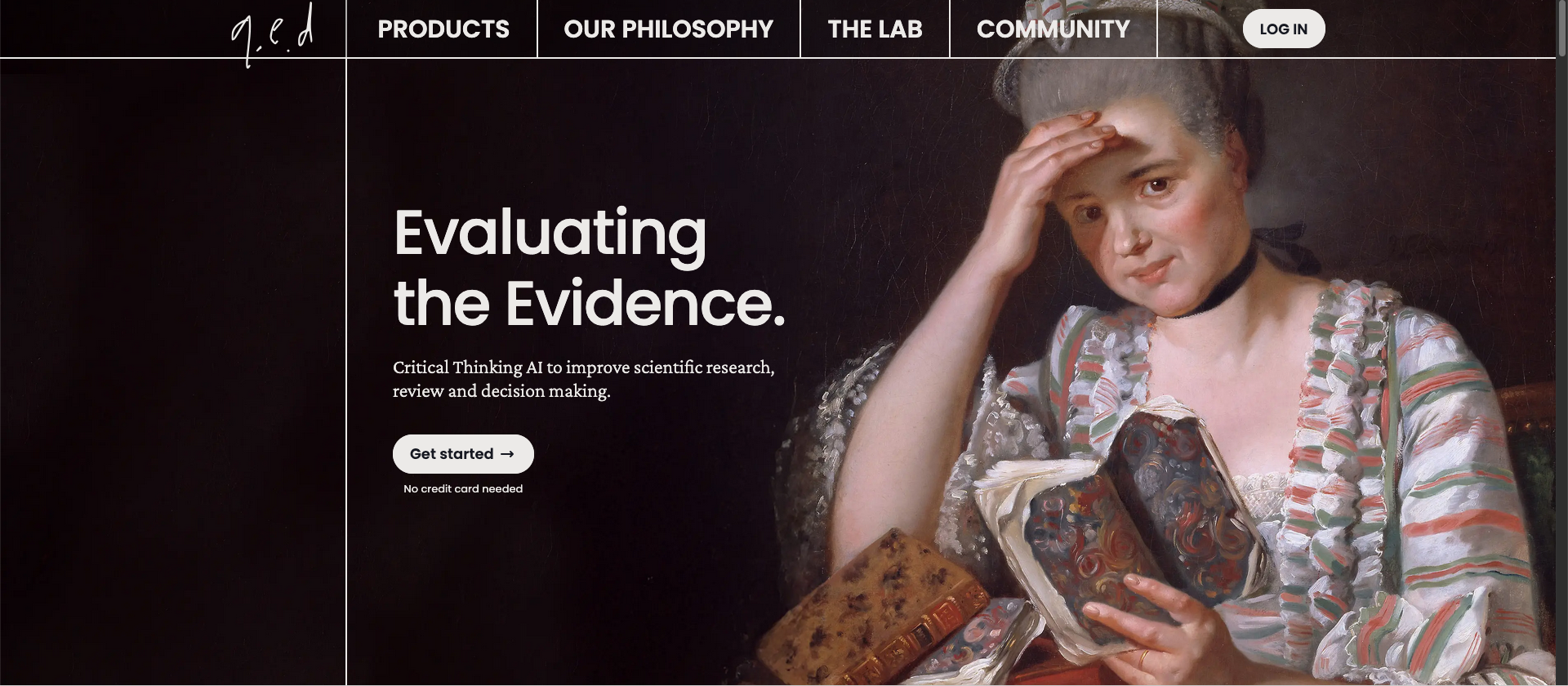
The choice of image is a little bizarre — a 1769 portrait of the aunt of artist Jacques-Louis David, best known for his painting, “Death of Socrates.” Auntie is reading tattered books, unlikely to be scientific because she wasn’t a scientist but a socialite.
- Boasting to be a “Critical Thinking AI,” QED Science isn’t demonstrating much evidence of current relevance or scientific context with this 18th-century art choice.
- There’s also the anthropomorphism of “thinking” to deal with, but surely that’s obvious by now.
As part of the announcement, there was an in-person celebration, with Richard Sever and QED’s Oded Rechavi posing for a photo:

In the context of the announcement, the post from Rechavi runs from peak techno-utopianism to near incoherence: