Pod: More Harm Than Good
The Epstein Files, the Gates Foundation, and our role in the rise of feudalism

A recent episode of Paris Marx’s “Tech Won’t Save Us” podcast featured Tim Schwab, author of the 2023 book, The Bill Gates Problem: Reckoning with the Myth of the Good Billionaire. Revelations about Gates and Jeffrey Epstein have led to a reckoning at the Gates Foundation, making Schwab’s book more relevant and causing us to pause to revisit the role of the Gates Foundation — and funders in general — in the scientific and scholarly publishing space.
Founded to reputation-wash himself after Microsoft lost its 2001 anti-trust case — with Gates himself testifying in a memorable set of exchanges with equally memorable haircuts — the Gates Foundation’s reputation has been eroding for some time.
The Epstein Files may be the end of the line for this effort to put Gates on a pedestal.
Gates apologized to staff last month, but in an odd fashion, shadow-bragging about the women he’d bedded as part of his affairs. Melinda French Gates didn’t have much to say, and Schwab has called for Gates to step down from his foundation. Charlemagne tha God made Gates his “Donkey of the Day” recently for claiming that cheating on his wife multiple times was “nothing illicit.”
One habit of the Gates Foundation has been to use non-white people as props in their communications, what experts call a persistent “colonial lens,” which Melinda also seemed to peer through. This is in the portrait of the couple in the Smithsonian:

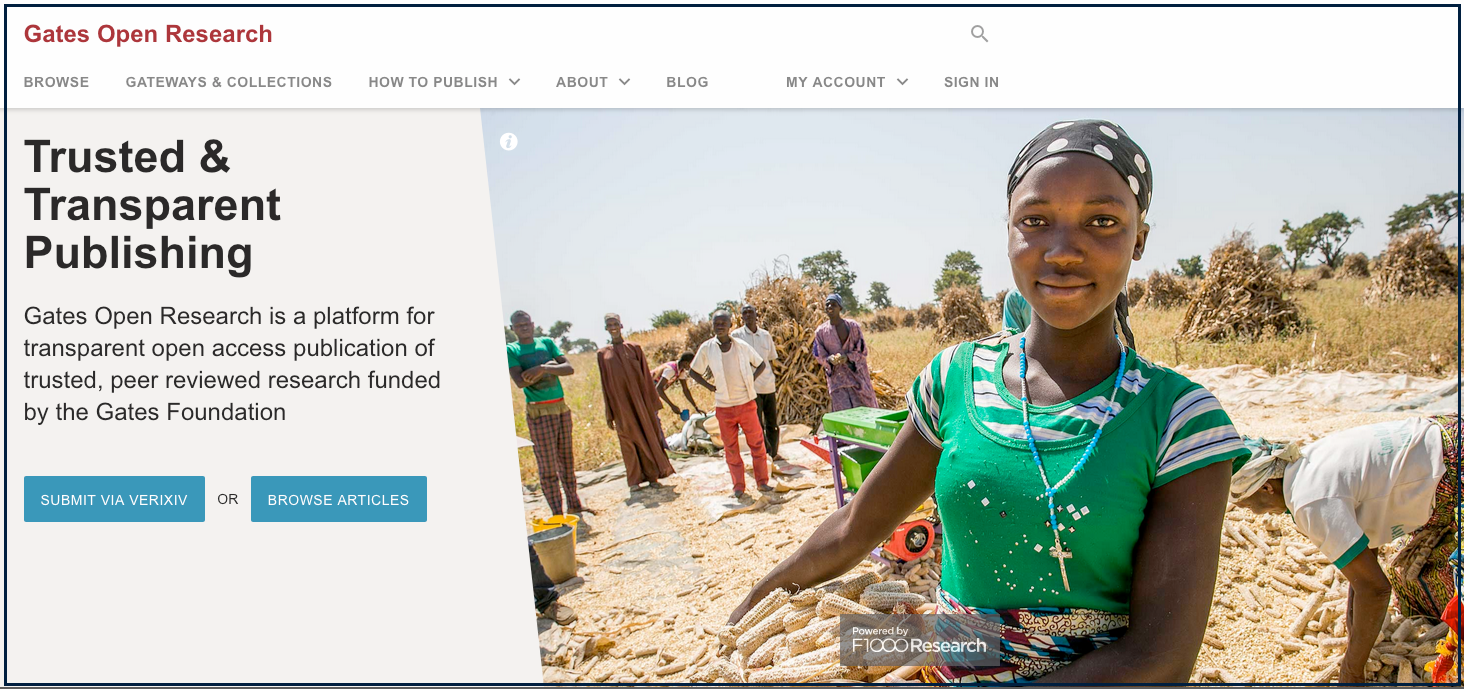
The colonial lens exists on the home page of Gates Open Research, where if you scroll further there is a pattern in the superfluous imagery of black women used as props for white male saviors:
Gates has said that the only way to make C-sections safe in Africa is to build robots in Silicon Valley and ship them there — because apparently human Africans aren’t capable of learning medicine, surgery, and OB/GYN techniques. Also, most of the money the Gates Foundation has given over the years has ended up in the US, Switzerland, and the UK, with 60% of it spent in the US on firms with high-salaried administrators, lobbyists, and bureaucrats — the plutocracy’s errand boys and girls.
As we write in our upcoming book, Gates is not alone in trying to use money to influence priorities in science, medicine, and scientific publishing:
Five funders rose to prominence in “open” scientific publishing relatively quickly — Max Planck, HHMI, Wellcome, Gates, and CZI — representing an interesting historical trajectory of wealth shifting from nation-states to manufacturing to chemistry to computer science to social media. In some ways, it is the preceding century in a nutshell.
All these rich influencers are proving problematic.
The fundamental problem is power, as David McCoy of the Centre for International Health and Development, University College London, says in Schwab’s book:
At the end of the day, a really good metric . . . to look at is: Has power been redistributed over the last twenty years since the Gates Foundation has been on the scene? And I think the evidence shows it hasn’t. If anything, inequality, in terms of power, [has] actually gotten worse. There’s been an even greater concentration of power and wealth in a few hands, even if lives have been saved during that time. By continuing to not address the more fundamental problems of structural inequality, and the injustice of that, they are able to maintain this position of being charitable and benevolent, which they are then able to translate, to turn into social power.
From influencing how and what journals prioritize and publish to driving agendas and IP decisions in world health, public health, vaccine development, and more, Gates and other rich funders have had an outsized influence without actual expertise.
For publishers who once were vaunted for their independence, Gold OA has effectively made us vassals relative to the patronage enabled by these concentrations of wealth and power — failing to disclose money flows around APCs, catering to mandates, making compromises to secure their funds, accepting their edicts, and serving their agendas. People are starstruck by the events they can hold, the prizes they fund, the journals they support, and more.
In the US, 300 billionaires made 19% of election donations in the latest cycle, spending 5:1 on right-wing candidates. (Before 2010, their spending on elections was 0.3%.) Many of these have been Silicon Valley titans, who have emerged as unexpected libertarian and right-wing allies.
Today, a new generation of pseudoscience grifters have taken this patronage playbook and rewritten it to support their anti-science lobbying and nutraceutical scams:
- Children’s Health Defense
- McCullough Foundation
- American Health Action
- MAHA Institute
- Independent Medical Alliance
- formerly Front Line COVID-19 Critical Care Alliance
- Brownstone Institute
- React19
- Moms Across America
- Food Fix Campaign
- Global Wellness Forum
Our questions: Are funders doing more harm than good? Has the structural change they’ve wrought in scientific publishing led to lasting damage? And where do we go from here?
“Discoveries of the Week”
- Virginia bluebirds: https://www.virginiabluebirds.org/our-history
Super fun to play on the piano.
Subscribe to our podcast
- Subscribe on Apple Podcasts
- Subscribe on Spotify
- Subscribe on Amazon Music/Audible
- Subscribe on YouTube
Music provided by Provoke the Truth — https://provokethetruth.net/