This Week’s Texted Discoveries
We are constantly sharing relevant stuff we find — here’s this week’s fetch
Happy New Year!
Not a reassuring discussion from the formerly respected Newton/Roose duo.
My kids and grandkids have returned to their homes. Back to the real world. I just emailed NIH Director Bhattacharya. My last email of the year (I hope). 1/13
— Jeremy Berg (@jeremymberg.bsky.social) 2025-12-27T00:54:24.908Z
Worth reading this addition to "50 Shades of Jay"
South Park Writer Owns the Trump-Kennedy Center Domain
A South Park writer bought the domains for the Trump-Kennedy Center back in August after predicting Trump would add his name to the institution.
 Jonah Krueger
AI Code Is a Bug-Filled Mess
A new report by AI software company CodeRabbit found that code generated by an AI was far more error-prone than human-written code.
 Victor Tangermann
My Open Letter To That Open Letter About AI In Writing And Publishing
The tl;dr before you get into this post is this: the SFWA came out, said that some AI usage was okay enough in books for the authors of those books to not to be disqualified from winning a Nebula a…
 terribleminds
Sauron, the high-end home security startup for ‘super premium’ customers, plucks a new CEO out of Sonos | TechCrunch
Sauron is appearing on the scene as concerns rise about crime among the most wealthy.
 Connie Loizos
The digital revolution has failed
The benefits of the internet are eroding. The AI boom is only accelerating their demise.
 Paris Marx
Prominent environmental health journal disappears, but it’s in transition
Environmental Health Perspectives, published by NIH for over 50 years, is suddenly gone but will soon move to a new, non-governmental publisher
 Rebecca Trager
Recommended Reading
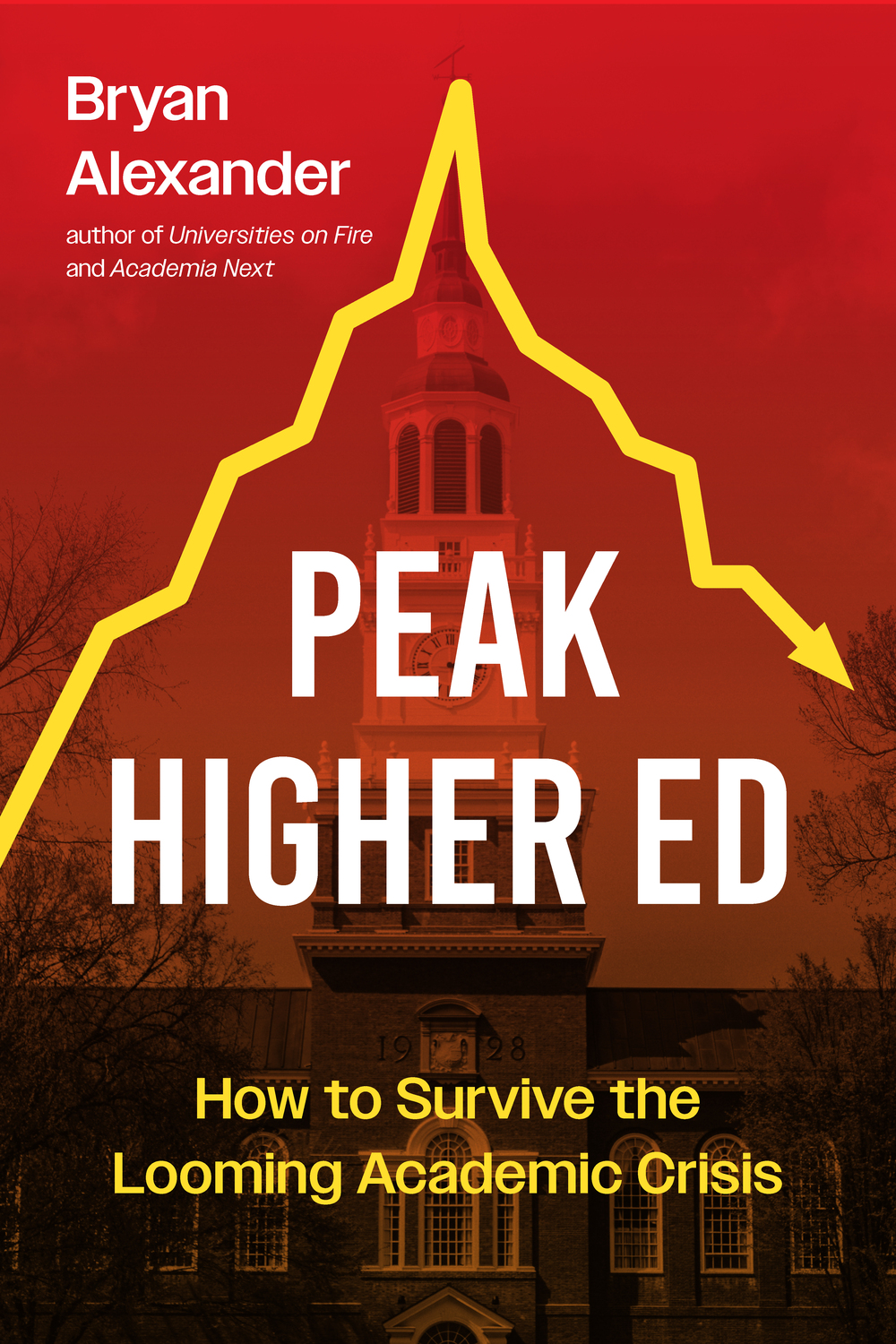
Peak Higher Ed
Mapping out the strategic future of higher education.Over the past decade, American colleges and universities have seen enrollment decline, campuses close, programs cut, faculty and staff laid off, and public confidence erode. In Peak Higher Ed, futurist Bryan Alexander forecasts what the next decade might hold if we continue down this path. He argues that the United States has passed its high-water mark for postsecondary education and now faces a critical turning point. How will higher ed institutions respond to this wave of change and crisis?Combining data-driven research with scenario modeling, Alexander outlines a powerful framework for understanding what led to this moment: declining birthrates, surging student debt, rising tuition, shifting political winds, and growing skepticism about the value of a college degree. He maps out how these forces, if left unchecked, could continue to reshape academia by shrinking its footprint, narrowing its mission, and jeopardizing its role in addressing the planet’s most pressing challenges, from climate change to artificial intelligence. Alexander explores how institutions might adapt or recover, presenting two possible futures: a path of managed descent and a more hopeful course of reinvention.Peak Higher Ed examines the fraying of the “college for all” consensus, the long shadow of pandemic-era disruptions, and the political polarization that has placed universities in the crosshairs. Written for educators, policymakers, students, and anyone invested in the future of higher learning, this book offers a deeply informed, unflinching look at the road ahead and the choices that will determine whether colleges and universities retreat from their peak or rise to a new one.
 Bryan Alexander