medRxiv Made the Monsters
Preprinters boast about saving a scrap of land from the creatures they made

A preprint on medRxiv posted January 5, 2025, was recently reanimated when the FDA blocked publication of a peer-reviewed version in a journal. The preprint indicated no new risks or differences among an older cohort of Covid-19 vaccine recipients. It looks like the peer-reviewed version would have presented good confirmatory epidemiology. We know Covid-19 vaccines are safe. Most of us have received a few by now.
- This followed hard on the heels of the CDC stifling another COVID-19 paper’s publication.
The science appears to demonstrate a narrative the current HHS doesn’t like — vaccines are safe — so publication was squelched.
- We live in the era of policy-based evidence, and the current HHS narrative is all about raising doubts about Covid-19 and other vaccines.
Out of nowhere, people at medRxiv/openRxiv began flexing, portraying themselves as heroes for having the preprint stored on their servers for the past 17 months:
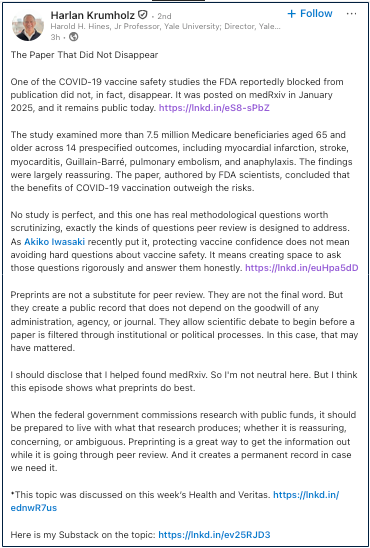
But as Robert Morris, an epidemiologist, wrote last week, medRxiv played a major role in elevating Jay Bhattacharya and other creatures of the Internet into their positions of authority over scientific publishing decisions like this.
It started in early 2020 with a notorious preprint on medRxiv:
In April of 2020, Jay Bhattacharya and colleagues conducted one of the most consequential studies of the entire pandemic. Its key finding was an estimate of the rate at which people with COVID were dying, the infection fatality rate. That estimate of 0.17% fed the belief that COVID was “no worse than the flu”. . . . The study was rapidly disseminated as a preprint and amplified through media before undergoing full scrutiny. While preprints are an important tool, in this case they functioned less as a step in scientific dialogue and more as a vehicle for immediate public influence. The authors heavily promoted the findings in the absence of peer review.
The study was partially funded by the CEO of JetBlue, who wanted more people flying sooner. It was ultimately published in a journal edited by one of the co-authors, John Ioannidis.
- Bhattacharya and John Ioannidis are listed consecutively on the editorial board of a “journal” Science described as possibly “used to sow doubt about scientific consensus on matters such as vaccine efficacy and safety.”
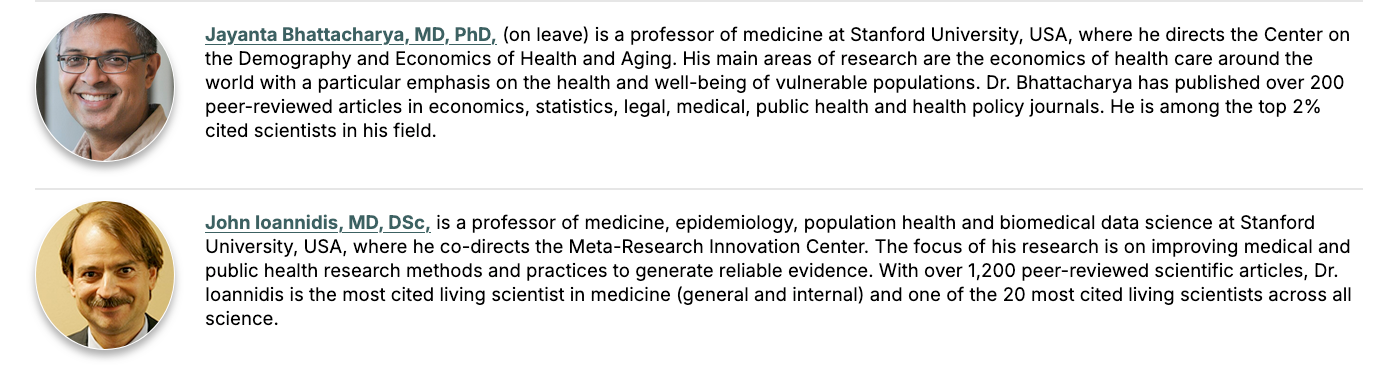
Bhattacharya’s wife — a radiation oncologist — got involved in the study, recruiting participants inappropriately.
- Remember, the same OA movement that spawned preprint servers like medRxiv also was a major contributor to the formation and emergence of MAHA.
The preprint fit a narrative Bhattacharya wanted to push when he served as a co-author of the infamous Great Barrington Declaration, which pushed for letting the virus burn through unimpeded by a vaccine. It was funded by the American Institute of Economic Research, a libertarian think-tank interested in keeping workers at work and businesses open. Their approach would have killed tens of thousands.
As usual, Krumholz is talking out of both sides of his mouth in his LinkedIn post, because he is Dr. JACC and Mr. Rxiv — a physician who wants to play cyberlibertarian “information wants to be free” games while also serving as editor of a serious scientific journal that takes its peer reviewed rejections seriously. He’s been playing with these monsters for years now.
- His missive on LinkedIn brings the phrase “slippery as an eel” to mind for me — not how I’d want an editor to come across.
Like the MAHA mavens of the modern policy-based science world, preprint advocates can stretch the truth to fit a narrative. They never seem to want to face the evidence of all the harm preprints have done. They are only interested in positive spin, not in facing the facts.
medRxiv played a major role in making the scientific Frankenstein that is MAHA. They need to own that.
They are not the heroes they want us to think they are.