This Week’s Texted Discoveries
We are constantly sharing relevant stuff we find — here’s this week’s fetch
First Cyclosporiasis Outbreak Deaths Reported In Michigan
Michigan health officials reported two cyclosporiasis-linked deaths Monday, as total cases in the state surpass 11,000.
 Conor Murray
‘A waste of time for all of us’: caught in the crossfire of the peer-review wars
Review mills — researchers who write fake referee reports with coercive citation requests — are setting off a war in academic publishing. What happens to those caught in the middle?


Is it safe to drink Red Bull and alcohol? Questionable research tied to energy drink giant has shaped policy
Studies tied to Red Bull helped block warning labels about drinking alcohol along with energy drinks. Independent studies report risks in mixing the two.
 Sasha Chavkin, Ashley Okwuosa, Fernanda Aguirre Ruiz, Romina Colman
Short answer: No.
Ashish Jha’s Reactionary Crashout
From COVID Czar to... CEO of a GenAI Scam?!
 JJ Kogburne
The great inflammation panic
The wellness world’s favorite buzzword has gone federal. For those of us with real inflammatory disorders, the misinformation isn’t just annoying—it’s harmful.
 Julia Métraux
Springer Nature reports strong first-half growth - Research Information
Growth across journals portfolio, continued expansion of its transformative agreement programme and increasing use of AI


Much slop? How else is every major publisher growing faster than the market . . . ??
The Bethesda Declaration: NIH Scientists Speak Out Against Political Interference
Podcast Episode · We Want Them Infected Podcast · July 22 · 1h 3m
 Episode Webpage
Medical journals, law reviews, and literary magazines are grappling with AI-generated submissions - The Boston Globe
While these publications serve relatively narrow audiences, their contributions are key for new thinking about the world.
 Print this Article View Comments
Scientists using LLMs will ‘do more, less well’, modelling study predicts
Research suggests that the combination of incentives to publish and the use of large language models will lead to more papers, but they will be less refined.
 Kaia Glickman
PLOS Peer Review Process Flawed in Published Paper | Dominique Bachelet posted on the topic | LinkedIn
Note to scientists who have been or are thinking about publishing in the journal PLOS. Today my colleague and I received a letter from the “PLOS Publication Ethics Team” about a paper we published in that journal 7 years ago, stating:
“This article was recently investigated as it was identified as one of a series of submissions for which there are concerns about the peer review process. Based on this assessment, the editors have determined that peer review for your article was unreliable. We sincerely regret that the concerns were not identified prior to the article’s publication.” The editors gracefully stated that they “do not have concerns regarding the authors’ conduct during the peer review process, and [they] did not evaluate the article’s integrity or scientific validity as part of this reassessment.” BUT, our paper will now include a letter of infamy/header with an “Expression of concern to inform readers of the peer review concerns so they can take this into consideration when interpreting the article”. We were amazed and not a little upset about this turn of event. We do not mind being rejected by reviewers but to get review comments, address them, told the paper was then accepted and 7 years later told the review process had been flawed, and given a publication banner that gives an impression of unreliability, something is definitely rotten in PLOS editorial land. #scientificpublication #reviewprocess #scientificreview | 88 comments on LinkedIn
 Dominique Bachelet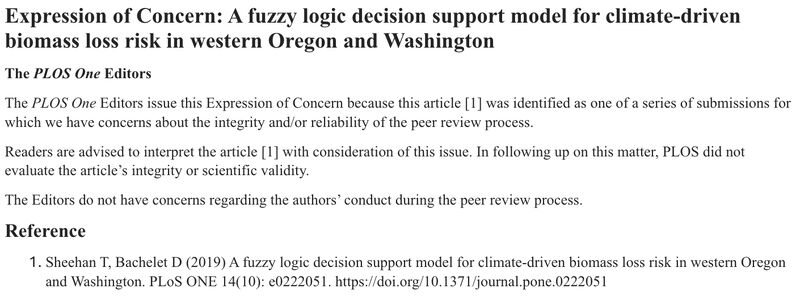
What if AI systems weren't chatbots? | Naomi Truan | 14 comments
AI didn’t have to talk to you. That was a design decision -- possibly to make you use it more. The chatbot interface is not a neutral packaging choice but the dominant sociotechnical form AI now takes, and its defining trick is projecting confidence and authority even where it serves users badly in complex, high-stakes contexts. Would you make important decisions in a quick chat between meetings? A fascinating new paper argues we should stop treating the chatbot interface as inevitable, explicitly calling for “imagining alternatives”: https://lnkd.in/d5ykUUqB “Alternative modalities could include visual parameter spaces, interactive simulations, rule-based editors, sliders, and structured query interfaces.” (there are no pages in the PDF, so I cannot cite precisely) | 14 comments on LinkedIn
 Naomi Truan