Updating “Pump and Dump Science”
A new documentary about crypto means it’s time to update a post from last year
In 2016, Patrick Joyce founded Knowledgr, described as “a public blockchain and open-access scientific platform designed to modernize the infrastructure for scientific funding, research, and publishing.”
Joyce was a medical student at Georgetown at the time, having already earned a BS in biology from Elon University, a PhD in molecular biology from Boston University, and an MS in clinical studies also from BU.
Not much seemed to be going on at Knowledgr except for some code posted on GitHub and last updated in 2019.
That same year, Brian Armstrong, the CEO of Coinbase, posted on Medium his idea for a system where “research happened more like open source software and was more aligned with market incentives. It would also be nice if there was prioritization like Reddit, comments like Google Docs, and pull requests like GitHub.”
It was a tech-culture crazy quilt. Armstrong would call this system ResearchHub.
Fast-forward to 2023, and a few odd things had transpired involving these people and entities:
- Joyce became the Chief Scientific Officer for ResearchHub in May 2020, after leaving Knowledgr in April 2020
- In 2021, Joyce became a Co-founder and COO for ResearchHub
- In 2021, blockchain accelerator MouseBelt Labs sued Armstrong, alleging he had offered to invest in Knowledgr so he could use confidential information for ResearchHub and eliminate Knowledgr as a competitor.
- MouseBelt also alleged that Armstrong contacted Joyce in June 2019 offering to personally invest $50,000 for a 1% share.
- The $50,000 was wired to Knowledgr in mid-July 2019.
- The case has since been referred to Federal court owing to jurisdictional issues including MouseBelt Labs being located outside the US.
- MouseBelt also alleged that Armstrong contacted Joyce in June 2019 offering to personally invest $50,000 for a 1% share.
- In 2024, Armstrong and Joyce were interviewed about ResearchHub on a crypto YouTube channel (Bankless), an interview that is notable for words like “DeSci” vs. “TradSci” for “decentralized science” vs. “traditional science,” and their profound insights into science as an activity where you can ask deep questions (e.g., “Why is the sky blue?”) and then find answers. Breathtaking how these guys understand everything with so little effort.
ResearchHub purports to pay reviewers using a coin called $RSC (research coin). Reviewers can earn up to $150 per review. ResearchHub has even partnered with the Center for Open Science around COS’ new Lifecycle Journal, a three-year experiment in open science publishing. As the press release states:
Through this partnership, submissions to Lifecycle Journal will be seamlessly integrated into ResearchHub’s platform, where peer review bounties will be assigned to encourage qualified researchers to provide timely and thorough evaluations.
Bounties are issued on papers to provoke reviews, creating a market, at least in theory. Users can unlock achievements. Upvotes equate with consensus. In other words, this is everything you’d expect from people who look like they might have a high score in some version of “Zelda.”
The press release claims ResearchHub users completed 3,204 peer reviews in 2024 in an average of 10 days each.
But did anyone get paid? How the payments work makes it seem that getting money out of ResearchHub is pretty tricky, and the value of a coin can fall fast.
ResearchHub has issued 1 billion RSCs, with 7.5M in circulation, and a max of 50M put into circulation in any given year. Of these, ResearchHub keeps 40% for itself, leaving 60% to pay others in tokens. While you might think the store of 1B RSCs would take 20 years to be circulated, because of this share split, it will be exhausted in 12 years. Only 5% of the 40% can be disbursed in any given year, and as of 2023 — the last time they have updated the information — ResearchHub has not hit this disbursement ceiling.
- These payment events are called “emissions.” Ick.
Holders of $RSC are mainly the “treasuries” of ResearchHub:
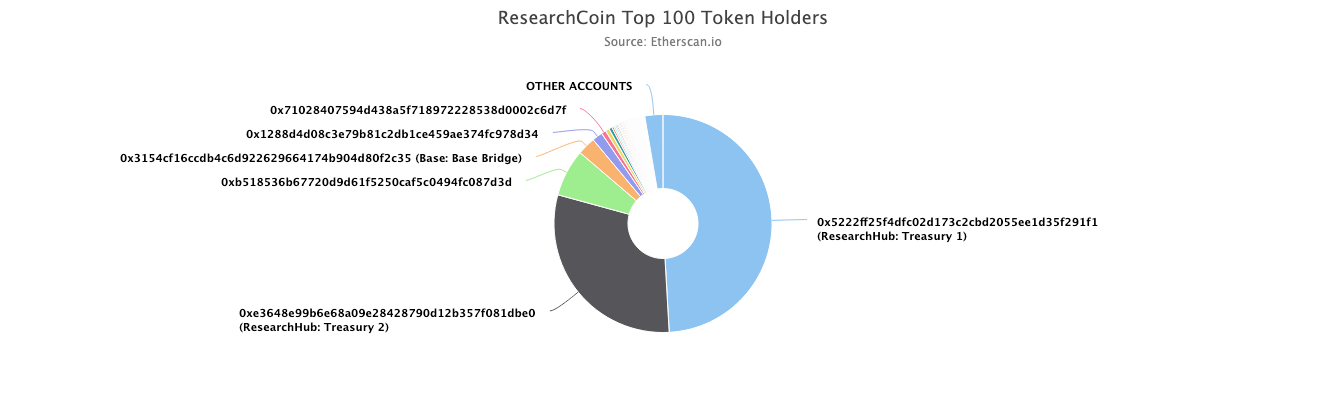
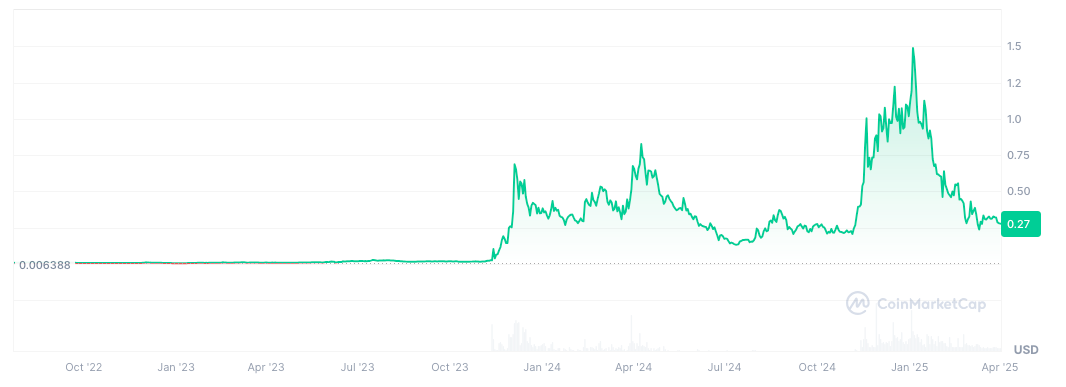
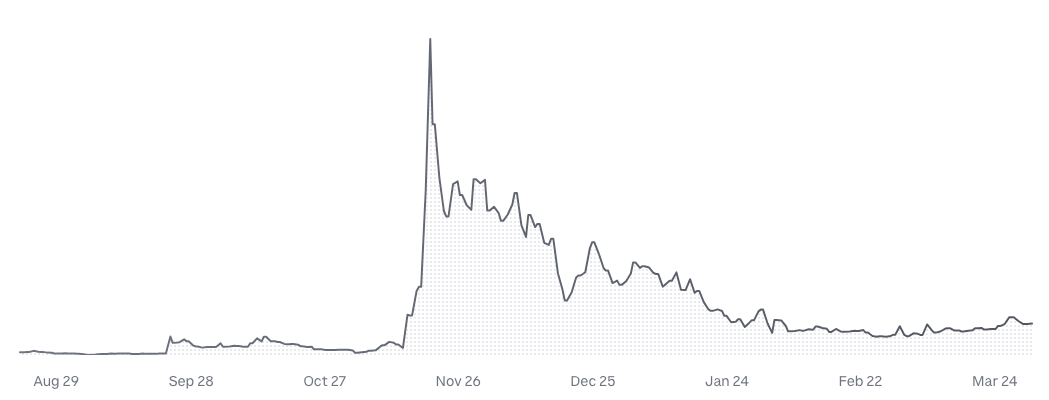
Each RSC token is now worth $0.28, and the value has been falling consistently recently, after peaking earlier this year. Transfers have also been occurring, but very little value has gone into these, according to analytics of the coin, and captured in this chart from another site:
A post from a PhD selling academic writing services on Twitter/X claims to show that a bounty for a review paid 230 RSC, or $139.60. However, that imputes a value of $0.60 per RSC, far more than the coin is worth now. At its current price, 230 RSC would be worth $64.
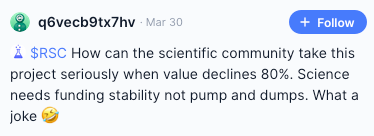
As one commenter puts it:
ResearchHub also purports to have a foundation, but there is no record of a registered charity or 501(c)3 with that name.
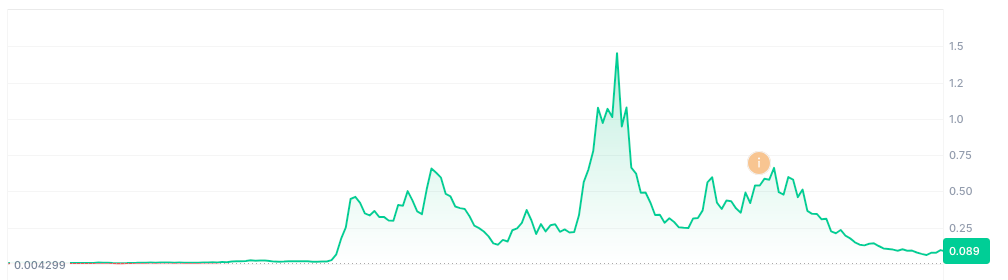
UPDATE — ResearchCoin value, all time:
This isn’t the first such scheme, certainly isn’t the only, and won’t be the last.
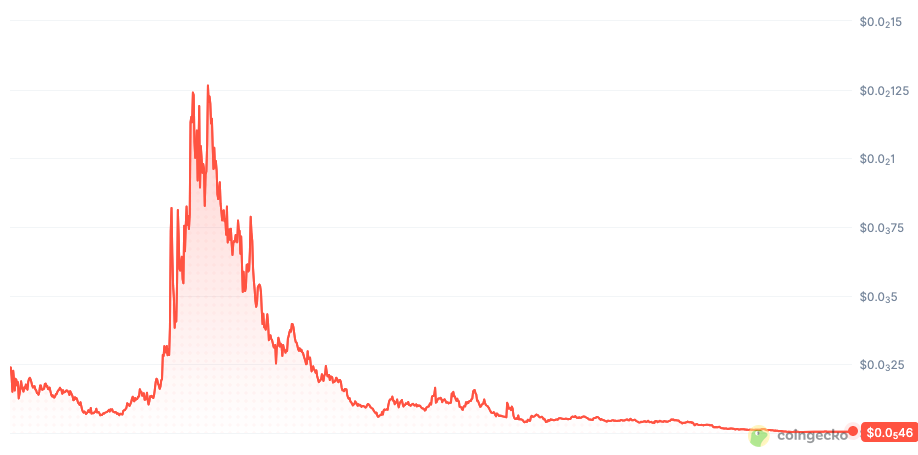
You may recall I wrote about Preprints.io, a “DeSci platform” as described on Coinbase, one still not allowed to trade on US centralized exchanges and now worth $0.02 per coin. At its peak, it was worth $0.17777.
This was part of speculation that OA is ripe for money laundering, based on the proliferation of pump and dump coin schemes, the mysteries of where all the money behind the flood of papers is coming from, and how easy it would be to generate fake papers to hide fake payments to oneself in order to launder money.
UPDATE — Value of PRNT coin, all time:
As McKenzie says, it’s a zero-sum game, and there is nothing but a transfer of money from the base to the top going on, as in a classic Ponzi scheme.
Scientific publishing has been hoodwinked by crypto operators, too.