Pay to Play In OpenEvidence
LLMs treat OA pay-to-play articles the same as any other, and that's a problem
I recently wrote about a couple of egregious problems with AI slop at OpenEvidence. In that post, I described how the LLM served up a resuscitated eugenics fantasy about IQ and fluoride, while giving too much credence to a flawed study about the environmental risks of living near a golf course. It was all made to sound authoritative and reasonable despite being neither.
There is a common theme to both of the articles that ended up with inflated importance at OpenEvidence. It’s a theme academics either miss entirely, downplay, or refuse to believe — they were both published Gold OA, which puts them in a category more akin to ads.
Functional medicine is one of the most prominent and controversial areas related to MAHA, nutraceuticals, and shamanistic science, with the nominee for Surgeon General being a self-proclaimed functional medicine physician.
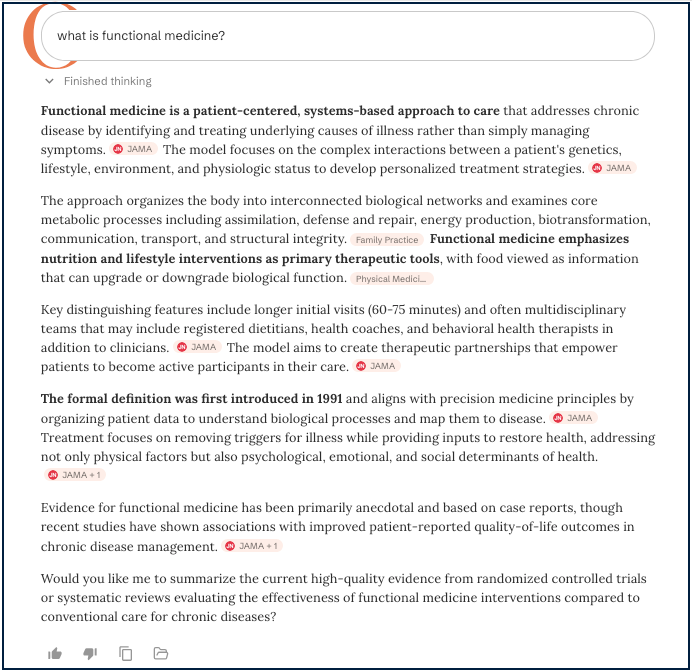
Being a curious person, I asked OpenEvidence to explain functional medicine to me. Here’s its response:
Other actual human experts have more blunt assessments of functional medicine:
- Science-based Medicine: “. . . a form of pseudomedicine that dresses itself up as scientific but at its core is deeply unscientific.”
- Dr. Greg McGuire: “bullshit.”
- McGill Office for Science and Society: “Functional Medicine Is a Pipeline to Alt Med”
What evidence did the LLM rely upon to present me with this anodyne and reassuring explanation of an expanding, RFK, Jr.-approved grift?
- A 2019 JAMA Network Open study of patient perceptions around functional medicine
- This study was promoted on an Institute of Functional Medicine page as “the first-ever study on the functional medicine model of care”
- A 2020 PLOS ONE retrospective analysis of patient perceptions around arthritis outcomes involving functional medicine
- This paper shared key authors with the JAMA Network Open paper, and had a similar study design, suggesting a coordinated effort to seed the literature
- A write-up of functional medicine in a “journal” put out by a medical communications company
- An article published in an Elsevier journal (Physical Medicine and Rehabilitation Clinics of North America) by one of the most infamous people in the space, Mark Hyman (he is a co-author on the PLOS ONE article, as well)
- Another article which is essentially a repurposed book chapter from a functional medicine guide
- A citation to an alternative medicine journal
Of the 11 citations in the OpenEvidence response, seven (63%) are from the one JAMA Network Open article. This article was interpreted by the inimitable David Gorski shortly after publication as follows:

Of course, the branding on OpenEvidence is misleading. References look like citations to a world-renowned medical journal — [JAMA] — when in fact they are references to the OA catchall at the bottom of a 12-journal cascade:

The brand management at JAMA isn’t what it used to be, at least not in this context.
How useless is this functional medicine study in JAMA Network Open? Gorski summarized it as follows:
. . . this study doesn’t show improved health outcomes due to functional medicine. Its primary outcomes were scores on subjective scales, not any measured hard outcome, such as blood pressure control, incidence of complications (i.e., strokes in patients with hypertension or blindness or loss of limbs in diabetics). Worse, it didn’t even really show what the very scales used consider to be a meaningful or significant improvement in health-related quality of life. It’s basically a whole lot of nothing, far more PR than anything else, and I expect that this study will be used to market functional medicine and try to convince conventional doctors that functional medicine has merit.
And now OpenEvidence is using a shoddy study that’s more “advertisement” than anything — paid for by the people seeking to benefit from more utilization of their pseudomedicine interventions — as the majority of the citations undergirding its explanation of “functional medicine.” And given what we think we know about LLMs, the study will probably influence various responses forever.
- Well played, Cleveland Clinic and your new friends in the functional medicine griftzone. Money well spent.
As for Mark Hyman, the article in the Elsevier journal appeared when he was still Director of the Center for Functional Medicine at the Cleveland Clinic, which he founded in 2014. Oddly, however, in this 2022 article, the address he gave for his Cleveland Clinic affiliation was in Lenox, MA, not Cleveland, OH. Look it up, and it’s the same as his another one of his initiatives, The UltraWellness Center, pictured below courtesy of Google Maps:

Hyman was replaced at Cleveland Clinic sometime in 2023, along with his co-author on the article, Elizabeth Bradley, who now runs the Advanced Functional Medicine and Longevity Center, “a leading virtual-based medical practice dedicated to personalized holistic care.”
Hyman’s Wikipedia page reads like a rap sheet given the way vaccines and public health have now been gutted:
- He collaborated with RFK, Jr., on his 2014 book, Thimerosal: Let the Science Speak, advocating for the removal of thimerosal in his preface
- He joined in calls for investigations into fluoridation policies in communities
- He claimed on a podcast that autism could be caused by eating gluten or by childhood vaccines
- He co-founded Function Health, a personalized health company funded by Andreesen Horowitz, Wisdom.vc, Draft Ventures, K5 and G9 Ventures, and others.
- This company misrepresents lab findings in order to fool people into seeking treatments — unproven, in most cases — when none are needed
- In 2024, he signed with the talent agency, WME
- He was part of the group of influencers who urged the FDA to ban red dye #3
His rather bizarre personal story was the subject of December 2024 profile in the New York Times. He’s also an educator at the Functional Medicine Coaching Academy.
- Hyman became the subject of a fun video analysis last year after he decided to drop in to someone’s Instagram account uninvited.
- Men over 60 with abs? Always suspect, strong whiff of desperation or compensation.
But back to OpenEvidence. Jonathan Jarry of the McGill Office for Science and Society describes functional medicine in this way:
Make no mistake: functional medicine is not a specialty of medicine. It is a slippery slide that moves healthcare providers into alternative medicine. Under the seductive luster of marketing verbiage, its goal is clear: test for as many things as possible and load the patient up with dietary supplements.
Functional medicine often does this while asking clients to pay at the time of service via HSA accounts in order to avoid insurance complexity and payment delays. Involving insurers might also make its practitioners accountable and subject to fraud investigations.
Once again, we have the same problems with OpenEvidence — an exaggeration of the limited evidence in the data store, injections of shoddy science by pay-to-play authors paying for what are more or less ads in disguise, and a presentation routine that doesn’t provide the kind of context, qualifications, or care a smart human would.
- Some are catching on to the problems with all this, using Cory Doctorow’s “enshittification“ to describe the changes. They are correct, but it’s suddenly so much worse thanks to these LLMs. They eat shit and serve it back to us disguised as healthy salads.
As I wrote a few weeks ago about other bad studies wrongly presented by OpenEvidence as solid and reliable despite being Gold OA paid placements by at least a few ne’er-do-wells:
This is exactly what we’ve been worried about — AI systems certifying bad studies placed by paying customers with agendas, presenting them with more authority than the information merits, and baking in controversial studies as if they are definitive and pure as the driven snow.
LLMs in medicine are making Gold OA pay off even more, allowing grifters like Hyman to plant “cloaked science” in systems that brands like NEJM and JAMA are telling physicians to trust, obscuring the source’s problems and payola all the while. We’ve become complicit in so much here.
Also, OpenEvidence is now running its own ads above the search bar trying to convince you that it’s all OK.
It’s not. It’s not OK at all . . .