The Aesthetics of Science Grifts
By emphasizing health and wealth, it’s clear that what’s on offer isn’t science
If you’ve worked in biomedical publishing for very long, you know that biology and medicine are not always pretty. It can be downright shocking how far our bodies can stray when things go awry — tumors, infections, trauma, deformities, and aging can all provide shocking reminders of our frail humanity.
Even within the “wide range of normal,” there are disgusting aspects. There’s a reason we all close the bathroom door.
You also know the fluorescent lights, dingy linoleum, worn out staircases, and faltering infrastructure involved in getting to and from settings where biological science is done and practiced — the labs, the universities, the hospitals, the clinics, the urgent cares.
Contrast what actually happens in medicine and biological science with the aesthetic constraints of pseudoscience grifts, and there’s something informative. Pseudoscience is always either harping on the invisible (vaccines, gut health, strength, or vitality) or teasing the target’s vanity (glow, tone, youth, or attractiveness). And there is always a component of affluence — spas, fluffy towels, sparkly glass, and nice stonework.
The pitch is that you can be both healthy and wealthy.
- What was once for the “worried well” has been upgraded to pitches to the “worried wealthy.”
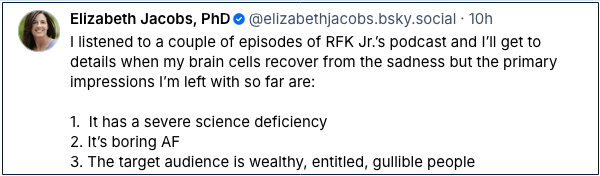
A recent post from the great Elizabeth Jacobs confirmed this impression from the headwaters of wellness grifting:
“Gut health” for the grifters will never touch on life-threatening constipation, bezoars, ostomy bags, colon resections, rectal prolapses, anal cancers, sexual acts, hemorrhoids, colon cancers, or appendicitis.
- I dare any grifter talking about gut health to spend one day observing routine colonoscopies.
Grifts have to be pretty and palatable.
One unexpected and inexplicable aspect has been the reemergence of Garamond Condensed as a display font. Embraced by the current White House, it goes back to early Apple ads, and can be found on David protein bars and more:
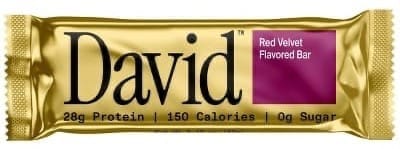

Why? No idea.
The aesthetic limits of wellness grifts quickly become monotonous. The pictures are all safe, never gross, never gritty, never clinical, never about elucidating reality. They are advertisements, posed, polished, and perfected, making an implicit promise that the ugliness of explosive diarrhea or a bleeding sarcoma or a broken limb will never disturb the placid world and gated communities of wealth and wellness.
The invisible is especially appealing, both to attack and promote. But attacking it means demonizing it, while promoting it means encoding it with fake visual markers so it can be sold.
- Demonization: How can that invisible vaccine work? It must be suspect, dangerous. You are too special to have something work reliably without being tuned to your unique physiology.
- Encoding: My equally invisible peptides work because you chose your own admixture of them using different colors and shapes of bottles and labels. You can’t trust science, but you can trust me and my retailing of the shapes and colors of mix-and-match pseudoscience.
- My invisible is better because I surround it with youth and beauty on social media, gamify it, and make it pretty.
The personalization of social media allows targeting that doesn’t happen in actual science, which does not hunt for targets but accepts people seeking relief of one kind or another (from injury, disease, or worry). Science is for everyone, ultimately. Grifting hunts customers, seeking profit, always scamming.
- Social media templates themselves create a downstream aesthetic embraced almost unconsciously by wellness grifters, with images optimized for feeds, widgets set up for sharing, and templates broken up in familiar dimensions that work best on phones.
- It’s not science. It’s sales.
How can you tell if that product is a grift?
Easy: The sun always shines in pseudoscience.