OpenEvidence Takes Colostrum
AI slop can start with OA slop, and OpenEvidence is willing to spew out both

Robert Wachter — best-known as the founder of the “hospitalist” movement in the 1990s — has been promoting OpenEvidence (OE) rather tirelessly lately, endorsing it in a press release last June, again in a recent interview with NEJM Catalyst, in other interviews, and in his recent book, A Giant Leap: How AI Is Transforming Healthcare and What That Means for Our Future.
He claims to have no financial ties to OE.
Wachter’s supposed “giant leap” boils down to LLMs that give him basic medical advice (a patient with Afib should be on blood thinners, for instance), affirming parasocial relationships at work, a book to sell, and a feeling that he’s 5-10% better at his job.
- In his book, he quotes OE’s founder Daniel Nadler about how Reinforcement Learning from Human Feedback (RLHF) workers helped make OE “stop saying racist shit.” Wachter is apparently oblivious to the exploitation of workers in marginalized communities — including healthcare workers and medical scientists — for RLHF tasks like data tagging, and the toll eliminating “racist shit” and worse can take on their psyches, families, and relationships.
With these modest and debatable claims of benefit atop ignorance of the human and other costs of the LLMs he celebrates, Wachter also keeps anthropomorphizing OE by saying things like, “It’s smarter than I am.”
Let’s keep Wachter’s feelings of inferiority to an LLM in mind as we check on how OE answers a question about bovine colostrum powder, an extension of my post yesterday about how the science claims of ARMRA, one of the most prominent peddlers of bovine colostrum powder, are based on pay-to-play OA.
Certainly, something as smart and pure as OE would never accept paid article placements as evidence?
On a whim the other day, I asked OE, “does colostrum powder work?”
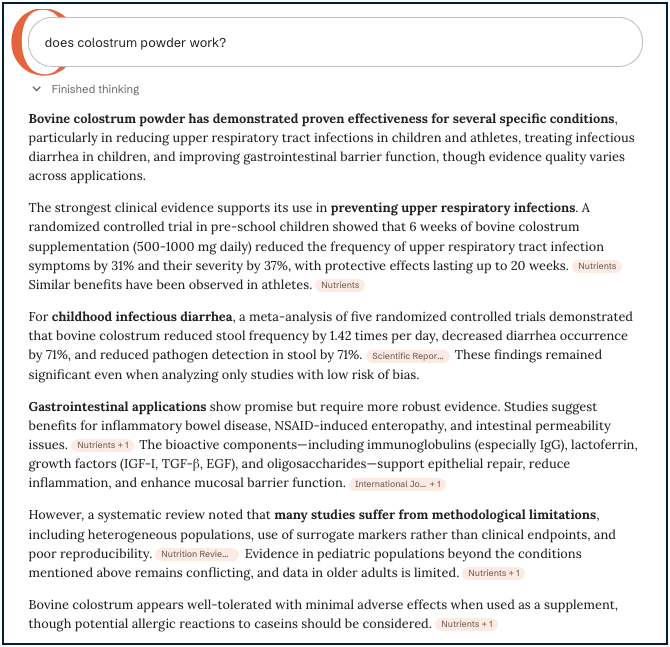
Long story short, OE responded that colostrum powder has “proven effectiveness” and multiple valid clinical uses.
What kind of evidence is it drawing from to arrive at these conclusions?
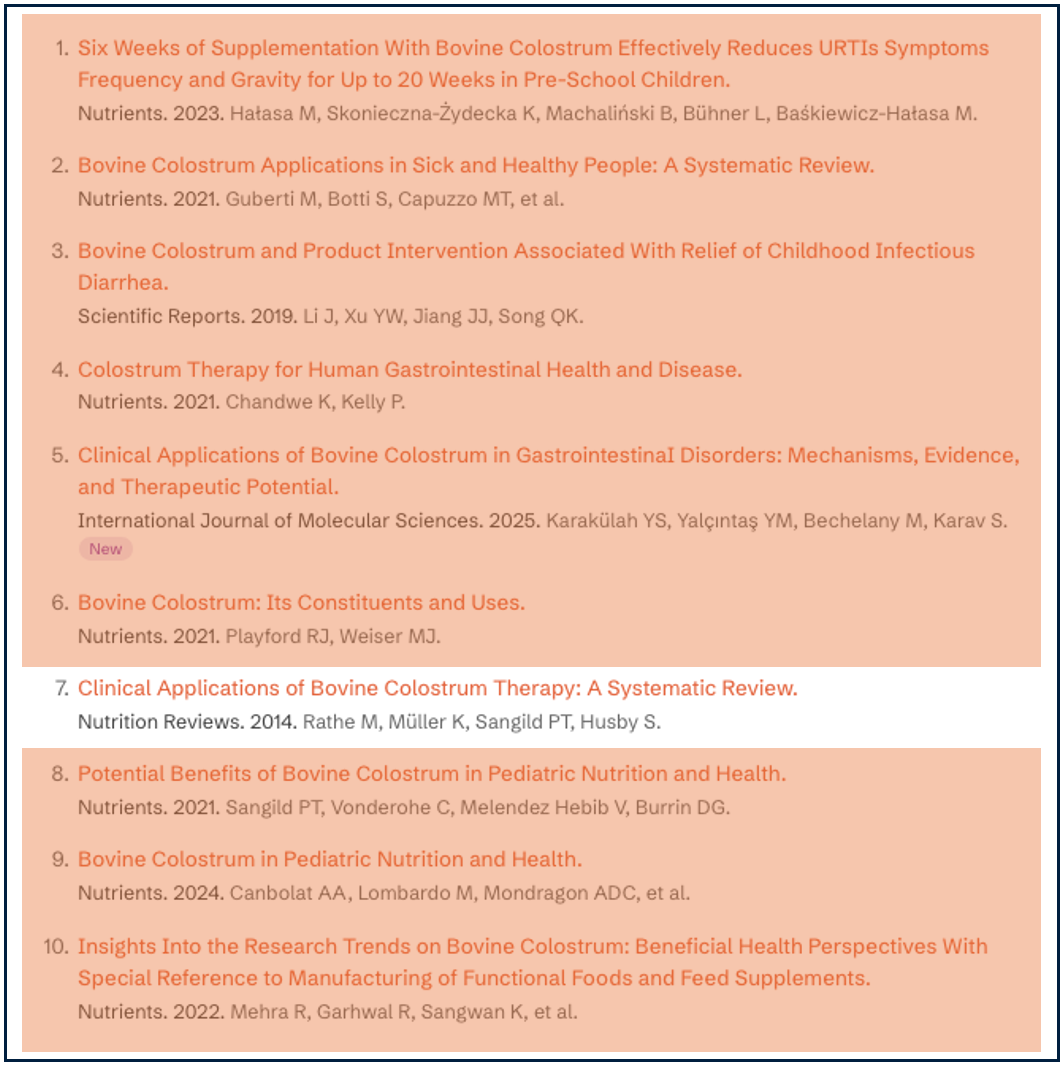
Here are the references it provided, with those in pay-to-play OA journals highlighted in peach once again:
The first study which OE describes as offering “the strongest clinical evidence” was a trial of 57 children randomized into two groups — one group received a little colostrum powder, the other a little whey powder, both for a little while. The results were gathered via an online survey. The study was meant to assess severity of upper-respiratory tract infections, but no child studied was confirmed to have contracted such an infection during the study period — it was just conducted during the normal cold and flu season. Children were not assessed by physicians or health care workers. This means there was no “clinical evidence,” just a brief period where kids took either colostrum powder or whey powder in an unsupervised manner, with their parents responding to a survey about coughs and colds. Illnesses were few and far between. It doesn’t appear the researchers accounted for potential confounders like age, weight, gender, underlying health conditions, allergies, asthma, siblings in the home, socioeconomic status, vaccination status, other medications taken, or similar predictors of doing better or worse with a runny nose and cough.
The study was submitted to the MDPI journal Nutrition on July 22, 2023, accepted on August 16, 2023, and published August 18, 2023.
The lead author disclosed that he was paid by Genactiv, a Polish colostrum powder company. He also wrote a book. My search engine translated the title as Colostrum. Natural regulator of the immune system.
The lead author of another MDPI colostrum powder paper cited by OE is the medical director at PanTherx, Inc., “a premier health and nutrition company dedicated to the commercialization of category-leading products and solutions for the human health & wellness markets.”
Another paper has an author affiliated with NutraV, creators of immune-boosting supplements.
- The only paper cited that describes numerous methodological limitations to the underlying science is an old paywalled article in an OUP journal.
As with the ARMRA evidence, the colostrum evidence cited by OE is dominated by MDPI pay-to-play OA papers (80%). Many of the authors have clear commercial interests, and because APC payers aren’t disclosed, we can’t know who paid to place these articles-as-advertisements.
- Can we call this “OA slop” now?
As noted yesterday and last week, PubMed and PMC a big role in laundering bad information through unearned government side-endorsement, as every reference in OE links to the article’s PubMed or PMC entry, not directly to the source. It’s a list obscuring sources behind government gauze.
Just as with OE’s response about “functional medicine,” its response about colostrum is based on pay-to-play OA, its summary full of undisclosed financial ties and conflicts of interest. There are even more instances of pure AI slop in OE based on other pay-to-play OA articles. Other examples are actually fairly easy to find.
Comparing the response from OE to the response from Grok.ai as represented in the new and problematic realfood.gov, OE is far less nuanced:
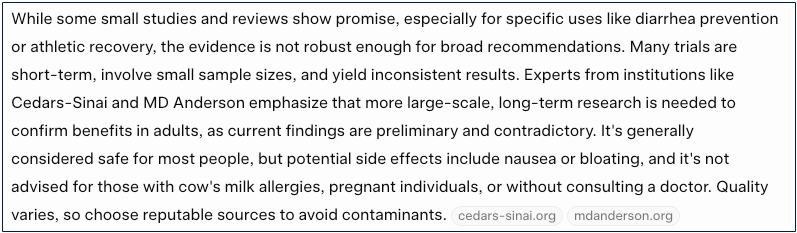
Even then, two of the main sources of the positive side of the Grok-government response come from an OA article from authors with clear commercial ties, and a press release.
As we’ve feared, OA slop is leading to AI slop. Grifters in the nutraceutical and wellness spaces are thriving because they have been empowered by OA, MAHA, and now AI, with scientific publishers as their poorly paid collaborators, providing outlets, infrastructure, and credibility, all for one low price (an APC).
Even worse, OE is benefiting from a massive overvaluation thanks to uninformed, unskeptical cheerleading by tech-enthusiasts like Wachter and other enablers.
One is our favorite double-talking editor, Harlan Krumholz, who recently claimed OE is “outpacing what physicians can do.”
- Krumholz has stock options in OE, so his promotion of OE is also pay-to-play.
Why there’s cheerleading at NEJM and JAMA — two brands I will caution again are playing with absolute AI fire at this point — is less clear. Whatever the motivation, they seem oblivious to the risks to two of the finest epistemic brands in medicine, with the message below popping up on a recent visit as OE tests out its ad designs:
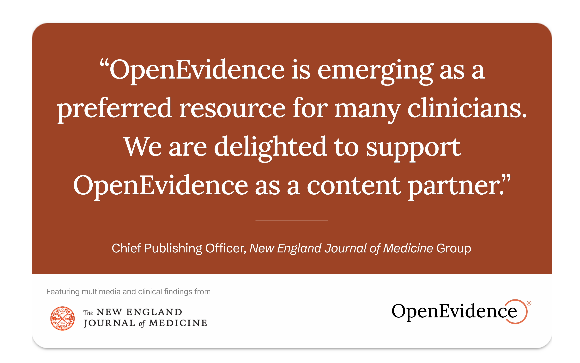
OE may indeed be smarter than Wachter and Krumholz. The company — and, by extension, its tech — is finding them and their tractable natures useful, after all.
- Meanwhile, the editors at Ars Technica showed more integrity this week around LLMs and empiricism.
- This also raises the question again about whether we can manage LLMs at all, as the victim of the “hit piece” in question discusses in his recap.
People too often degrade themselves and their professions at the feet of tech totems they have failed to interrogate or view skeptically. It’s quasi-religious tomfoolery that is antithetical to the purposes of these intellectual tentpoles and science cultures. It is already proving embarrassing. Worse, it’s not fixable because the tech is so bad and pay-to-play OA so prevalent.
We’re choosing to be exploited by false computer gods.
Nothing about this is smart. Just like academia, a lot of scientific publishers have become the AI bubble’s useful idiots.
We’ll stick with the people who actually use their brains . . .
Some Early Praise . . .